bettilt paribahis giriß bahsegel bahsegel giriß paribahis giriß bahsegel bahsegel bettilt bettilt bettilt bettilt bahsegel bahsegel giriß bahsegel

Her tĂŒr spor dalında bahis yapma imkanı sağlayan bettilt geniß bir kategoriye sahiptir.

bahsegel bahsegel bahsegel bahsegel giriß

PwC raporuna göre online casino sektörĂŒndeki yıllık bĂŒyĂŒme oranı %9 civarındadır ve bettilt giriß bu trendin TĂŒrkiye’deki temsilcisidir.

paribahis giriß paribahis paribahis giriß bahsegel giriß bahsegel

Scaling Culture — part one

by Josh Levine

This article is first in a series exploring the why, when, and how of managing company culture in growth organizations by Josh Levine.

Why It’s So Hard to Scale Company Culture

Sex in stairwells, absentee management, and outright racism. There’s been a spate of news recently about cultures going awry in Silicon Valley. While it’s the extreme cases here on the left coast that are making the headlines, errant cultures effect companies of all kind and size. It seems keeping culture from unraveling is a significant challenge every growth organization must learn to manage if its leaders intend to succeed in the long run.

In modestly sized organization, a limited set of individuals rely on one another to get work done, usually becoming a tight bunch in the process. Let’s call this an intimate community: a group of people where “most of the members recognize and are recognized by many of the others”. By nature and necessity when put together individuals develop relationships, and when intimate communities form they enable the knowing of the “who’s and what’s” of the organization. (Everyone knows Shelby is the code base wizard; Sanjay broke the sales records last quarter.)

Read more…

Josh Levine is an educator, designer, and author, but above all, he is on a mission to help organizations design a culture advantage.

Preview Chapter 5: Recognition

by Shelby Jones

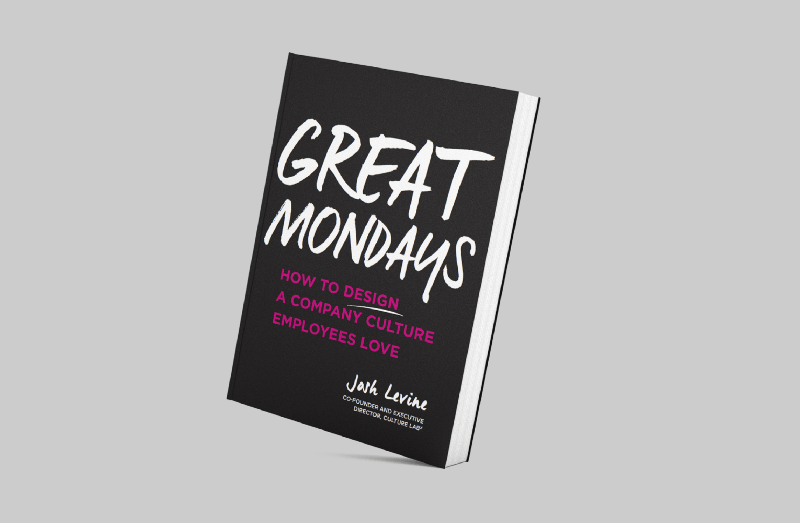
GREAT MONDAYS: How to Design a Company Culture Employees Love by Josh Levine

There are many types of recognition companies use to encourage positive behaviors. I wanted to see if I could make sense of them all. Here’s what I found.

Dogs. Chimps. Humans. We’re a lot alike. In addition to our four-chambered heart and love of social interaction, advanced mammals share a need for positive reinforcement. Managers have known this since the very first sales associate, using recognition programs to reinforce desired behaviors. But in my time studying company culture, I noticed there are many kinds of recognition, more than even a total rewards program includes. So, I went about looking for and sorting the different types to see if I could make sense of them all. Here’s what I found.

To actively manage your company culture, look for opportunities to recognize associates in the four different styles.

1. Formal Recognition from Leadership
Congratulations! You’ve done it. You’ve sold the most, coded the best, innovated the hardest. Whatever it is, you are being called out. Formal programs developed and implemented by heads of state are the most common example of recognition inside companies. In the early 2000’s I was involved in creating an innovation awards program for HP globally. We would put out a call for entries, film the judges, host a celebratory dinner, and bestow the trophies. Sometimes these programs can have monetary rewards or other gifts. Like this, formal recognition programs tend to be on a grand scale, but really, they don’t have to be. At a modest retail start-up I know, they hold a quarterly company-wide night out at the local pub and hand out tokens of appreciation to teams for great work.

WHAT YOU NEED

  • Leadership buy-in
  • Employee buy-in
  • Broad communications
  • A committed budget

Read more…

qual parts visual and verbal, Shelby dances between design and strategy at Great Mondays. She’s passionate about cereal, fashion, and family.

Do Companies that Mimic Nature Flourish Financially?

By Dawna Jones

Back in the early 1990’s investment advisor Joseph (Jay) Bragdon noticed the emergence of a new genre of company that was more adept at learning and more profitable than the corporate mainstream. Rather than following the corporate norm of prioritizing the growth of capital assets, the new model placed a higher value on living assets (people and Nature) on the premise that living assets are the source of capital assets.

To determine whether this difference in corporate philosophy and culture had meaningful advantages over the older system he created an investment research “learning lab” of 60 companies. In constructing the lab he aimed to identify firms in every major industry/sector that modeled best practices of living asset stewardship.

From the beginning his goal was to determine whether the sixty selected for such stewardship and higher purpose would outperform their peers. The short answer to this is ‘Yes!’ As his research progressed he found these leadership companies had attributes that mimicked life, and the deeper they went into modeling those attributes, the more profitable they became. This was a revolutionary discovery and it is the theme of his new book: Companies That Mimic Life: Leaders of the Emerging Corporate Renaissance.

As with his first book, Profit For Life, which introduced the 60-company learning lab -called the Global Living Asset Management Performance (LAMP) Index – all investment results have been verified by the consultancy Northfield Information Services. Beyond producing outstanding returns, LAMP60 companies are also recognized sustainability leaders whose average lives exceed a century. (By contrast, the average life of companies on the S&P 500 Index is only 18 years.)

Read the rest of the article here


About the Author:  Dawna Jones sees the underlying forces impacting what you see on the surface. She works with leaders and decision-makers to update skills and expand access to their wider intelligences. Working with individuals, teams, companies or at a global level gives Dawna insights into scaling mindset, innovation and transformation through leadership and decision-making. Contact Dawna on her website or follow her on Twitter.

Digital Transformation – Part VI: An Evolutionary Leap in Human Intelligence

By Rod Collins

“May you live in interesting times,” is an old English expression whose enigmatic meaning can make people wonder whether they’ve been offered a blessing or a curse. Regardless of the apparent well-wisher’s intentions, interesting times are oftentimes a blessing for some and a curse for others. The difference depends upon how capable and how fast people are in recognizing and embracing new ideas and new opportunities.

We, today, are clearly living in interesting times, perhaps the most interesting times in the history of human civilization. We find ourselves in the midst of a technological phenomenon that is far more transformative than previous technology revolutions because it is thoroughly, radically, and rapidly rewriting all the rules for how the world works. This phenomenon, which we have been calling Digital Transformation, is the fundamental architectural shift in the way the world works from top-down hierarchies to peer-to-peer networks.

Digital Transformation is much more than a technology revolution. It is arguably the most consequential socioeconomic revolution in human history because the transcendence of peer-to-peer networks will dramatically transform the basic contours of the human experience. This phenomenon is far bigger than most of us are prepared for because the vast majority of us are lacking in an understanding of the dynamics of networks. We are much more conversant in the mechanics of the hierarchical structures that have shaped the evolution of the human experience since the dawn of civilization. Unfortunately, our knowledge deficiencies in the ways of networks cause us to significantly underestimate the magnitude of the inflection point that is happening in the world around us as most remain blind to what is hidden in plain sight. If our interesting times are to become a blessing, we will need to quickly close our network knowledge gap because Digital Transformation is about to go into overdrive with the coming emergence of the Internet of Things (IoT). Once the IoT becomes the fundamental fabric of our everyday lives, what has been hidden in plain sight will become painfully obvious to those who fail to fill the knowledge gap.

Read the rest of the article here


About the Author:  Rod Collins (@collinsrod) is the Innovation Sherpa at Salt Flats and the author of Wiki Management: A Revolutionary New Model for a Rapidly Changing and Collaborative World (AMACOM Books).

Moving from a Controlling Mindset to Releasing Human Potential

By Dawna Jones

I am not the same person I was six months much less nine years ago. The journey to releasing my own potential began decades ago but it accelerated rapidly when my business crashed hard nine years ago. None of the efforts to clarify message, marketing or move my ideas forward gained traction. Only when I talked like everyone else did, were the ideas given credence. Stick in the mainstream and you are golden. Deviate and you will find yourself on the perimeter. Sliding down the slippery slope of believing that if I worked harder I could save it, the inevitable was unavoidable. In fairness, it was a year when many businesses crashed so I was not alone. Still, it felt like I had been slammed to the ground largely because my home went with it. It was a gift.

With the fall and dismantling of structure is the opening for releasing human potential.

No mistakes made. No regrets subtract from lessons and wisdom well earned. It was all part of a constant shedding of limiting beliefs to allow innate power and potential to emerge. Experimentation with removing all barriers to self-expression especially when confronted by judgment provided better insight into the transformational process from personal to organizational to global. Emotional awareness and calibration continued to release the past and open for new adventures. Along the way the path I took showed how and where societal expectations and social norms created habitual holding patterns. As if the internal challenge were not enough, the external challenge of not thinking, living or acting my age created questions about where I belonged. I could not help but wonder whether the contribution I could make fit in the world or had any value.

Looking back to the starting point, I recognize that I had repressed my own human potential swimming around in assumptions about how the world worked. Once you realize you are the one holding yourself back, there is nothing to stop you from releasing your deeper potential. The first step is to stop controlling what you can’t control, and start controlling your inner responses to outer events and experiences, which is well within your control.

Read the rest of the article here


About the Author:  Dawna Jones sees the underlying forces impacting what you see on the surface. She works with leaders and decision-makers to update skills and expand access to their wider intelligence. Working with individuals, teams, companies or at a global level gives Dawna insights into scaling mindset, innovation and transformation through leadership and decision-making. Contact Dawna on her website or follow her on Twitter.


Digital Transformation – Part IV: The Two Big Jobs To Be Done

By Rod Collins

One of Peter Drucker’s most popular and enduring business quotes is, “The best way to predict the future is to create it.” This advice has never been truer than it is today as the technologies of digital transformation are changing all the rules for how the world works by displacing top-down hierarchies that amplify the “power of one” with more powerful peer-to-peer networks that enable the “power of many.”

Another famous Drucker quote is, “If you don’t understand innovation, you don’t understand business.” That’s because when your job is to create the future—which is the fundamental responsibility of the business leader—you better have a firm grasp of how innovation works.

Understanding The Job To Be Done

Perhaps no one has advanced our knowledge on the workings of innovation more than Clayton Christensen, whose many books on the topic have become essential reading for twenty-first century business leaders. In his most recent book Competing Against Luck, which he co-wrote with Taddy Hall, Karen Dillon, and David Duncan, Christensen emphasizes that the starting point for innovation is often uncovering what he calls “the job to be done.” Whereas most attempts at business innovation often start with a product idea, Christensen urges business leaders to step back and take the time to uncover what problem customers are “hiring” their product to solve. If they fully understand that problem and use that knowledge to guide what products to make, they will not only delight their customers, but they may very well create something that has never existed before, which is the essential task of innovation.

Read the rest of the article here


About the Author:  Rod Collins (@collinsrod) is the Innovation Sherpa at Salt Flats and the author of Wiki Management: A Revolutionary New Model for a Rapidly Changing and Collaborative World (AMACOM Books).

Digital Transformation – Part V: Blockchain May Be the Future of IT

By Rod Collins

Morning Star is not your usual company. That’s because the 400-person California-based agribusiness has no supervisors. Rather than relying on the intelligence of an elite few, Morning Star is a highly successful self-managing peer-to-peer network that has skillfully leveraged the “power of many” to sustain its position as the world’s largest tomato processor.

From the beginning, the company’s founder, Chris Rufer, built his innovative enterprise on two core principles. First, individuals should keep their commitments to others. People at Morning Star are not handed assignments. Instead they negotiate Colleague Letters of Understanding with their co-workers, and, to assure everyone is honoring their commitments, the metrics associated with these agreements are published bi-weekly.

The second principle is that no individual should use force against others or their property. This means that no single person has the authority to issue an order or the ability to unilaterally fire another person. For the people at Morning Star, what they do and with whom they work are always collective decisions.

For over three decades, these two principles have served as a solid foundation to support an innovative management technology that is disrupting the way we build and lead human organizations.

Read the rest of the article here


About the Author:  Rod Collins (@collinsrod) is the Innovation Sherpa at Salt Flats and the author of Wiki Management: A Revolutionary New Model for a Rapidly Changing and Collaborative World (AMACOM Books).

3 Keys To Hiring High-Performing Frontline Leaders

By Sue Bingham

Manufacturing lives and dies by the numbers. Measurable data that tells you whether you have met production goals or are running at full capacity is an essential part of improving operations and safety at any well-run company. But leadership skills are what companies really need to grow and innovate.

Yet many frontline leaders (FLLs) don’t possess critical leadership skills — a discrepancy that can have dire consequences. At the heart of this problem are expectations set by senior leadership that are far too low. Consequently, traditional job descriptions often fail to communicate the skills that FLLs actually need to succeed.

For example, a low-expectation job description might state, “Do whatever it takes to make sure the job gets done,” whereas high-performance expectations require potential FLLs to “Inspire and develop a highly competent team that continuously produces the highest-quality products in the most cost-effective way.”

Low expectations result in the wrong people being promoted. Almost universally, companies promote their most loyal, reliable, and technically skilled operators to frontline supervisor positions. While these are highly valued attributes, notice how this list says nothing about leadership capabilities. Misleading expectations lead to front lines stacked with people who lack the aptitude to do the job — people promoted without the clarity of expectation at the highest levels of leadership.

Read the rest of the article here


About the Author:  Sue Bingham is the founder and principal of HPWP Group. She works closely with company leaders to analyze their organizations and facilitate the implementation of commonsense systems that have a positive impact on their organizations’ bottom line. She has a passion for helping companies embrace and transition to high-performance work environments. Sue is the bestselling author of Creating the High Performance Work Place. 

Digital Transformation – Part III: The Internet of Things Changes Everything

By Rod Collins

In 2006, Don Tapscott and Anthony D. Williams described in their book Wikinomics how a new phenomenon they called mass collaboration was going to change everything. They recognized that this unprecedented capacity for self-organization would give rise to powerful new models of production based on distributed peer-to-peer networks rather than centralized top-down hierarchies. Tapscott and Williams envisioned a world where this new way of organizing would eventually displace traditional corporate structures as the economy’s dominant engine for wealth creation. At the time, many critics dismissed the two authors as being carried away by breathless hype and overstating the impact of the digital revolution. While these critics acknowledged the obvious reality of fast-paced technological innovation, they scoffed at the notion that new technologies would radically change the fundamental dynamics for how our social structures work.

Given that more than a decade later the top-down hierarchy continues to remain the dominant organizational structure, it might be tempting to conclude the critics are right and that the notion that mass collaboration changes everything is indeed nothing more than hype. However, closure at this point might be premature because there’s increasing evidence that we are on the cusp of a new second wave of the digital revolution, which promises to be far more transformative than the already disruptive first wave.

First Wave: The Internet

The first wave of the digital revolution emerged with the dawn of the new century when the Internet created new ways to connect people and get things done. One of the interesting developments of this first wave is that it hasn’t affected all industries equally. If you are in the media, entertainment, retail, or communications industries, your world has been thoroughly transformed. Stalwart names, such as Border’s, Blockbuster, Kodak, Tower Records, and the Encyclopedia Britannica, have been either disrupted or displaced by the upstarts Amazon, Netflix, Apple, Spotify, and Wikipedia. However, if you work in the healthcare, insurance, energy, food processing, or, until recently, the financial services industries, your world has not been heavily impacted by this first wave. For these core economic industries, digital transformation has been essentially limited to digitizing existing product models. Unlike the media and retail industries whose basic business models have been radically disrupted, the longstanding models of the core economic industries have remained essentially the same.

Read the rest of the article here


About the Author:  Rod Collins (@collinsrod) is the Innovation Sherpa at Salt Flats and the author of Wiki Management: A Revolutionary New Model for a Rapidly Changing and Collaborative World (AMACOM Books).

The High Price of Overly Prescriptive HR Policies

by Sue Bingham

Recently, one of my colleagues left our firm to make significantly more money at another company. We wanted to keep her, but the commission-based salary offered by the other company was more than we could match. She hadn’t realized how long her new commute would be during rush hour, however, and after three days of long, round-trip commutes during rush-hour traffic, she asked to shift her schedule an hour earlier to spend less time in unproductive gridlock.

Her manager denied her request, saying, “If we did it for you, we’d have to do it for others.”

It was good news for us; she was back with our team the following Monday.

Too many companies’ HR policies are overly restrictive. Such policies are often convoluted and overly paternal, and attempt to control the behavior of regular people through rules designed to rein in the “bad apples.”

Having consulted with hundreds of company leaders on how to create high-performance workplaces over the past 30 years, I’ve seen this firsthand. Although a small percentage of employees may try to take advantage of more flexible or generous policies, designing your HR policies with such people in mind isn’t the answer. It won’t help boost the performance of the majority of employees – employees who have the organization’s best interests at heart. It will only make them feel distrusted.

Most employees who work for you are intelligent adults. If your employee handbook or HR policy manual is large and prescriptive, consider the following:

Read the rest of the article at Harvard Business Review…

About the Author:  Sue Bingham is the founder and principal of HPWP Group. She works closely with company leaders to analyze their organizations and facilitate the implementation of commonsense systems that have a positive impact on their organizations’ bottom line. She has a passion for helping companies embrace and transition to high-performance work environments. Sue is the bestselling author of Creating the High Performance Work Place. 

2