
bettilt paribahis giriĹź bahsegel bahsegel giriĹź paribahis giriĹź bahsegel bahsegel bettilt bettilt bettilt bettilt bahsegel bahsegel giriĹź bahsegel

Her tür spor dalında bahis yapma imkanı sağlayan bettilt geniş bir kategoriye sahiptir.

bahsegel bahsegel bahsegel bahsegel giriĹź

PwC raporuna göre online casino sektöründeki yıllık büyüme oranı %9 civarındadır ve bettilt giriş bu trendin Türkiye’deki temsilcisidir.

paribahis giriĹź paribahis paribahis giriĹź bahsegel giriĹź bahsegel

Are we really willing to face the real reasons for turnover?

By Brooke Erol


One of the challenges I hear from CEOs, entrepreneurs, Human Capital Directors is retaining great people. “Great” people here means they are a good fit for their position and are also aligned with values and culture of the organization. They tend to have the highest performance. They care about what they do and how they do it. They outperform since they use their strengths. As Gallup studies always find out, people using and improving our strengths are six times more likely to be engaged at work.

Many leaders I meet have major concerns about attracting, retaining, and replacing good talent. This is true everywhere. I had many trips to different countries where the common theme among executives is around low engagement and high turnover rates. Some leaders have good clues to the reasons why, some do not seem to have any answers.

Even though many leaders are concerned by turnover, they are not aware of the real cost of it.  You will be surprised to see the numbers.

According to Bersin by Deloitte Research, the average turnover rate is 13%. Thus, if an organization has 30,000 employees and an average voluntary turnover rate of 13 percent, the potential cost to the organization is a staggering $427.7 million in one year.  The problem is many managers look at the average direct cost only (which is $3,976 in average) that does not include interim cost of labor, training, orientation, indirect costs, lost productivity, and other factors that cause loss that totals up to $109K per person.

Read the rest of the article here…

Brooke Erol is an advisor, a speaker, and an author who is interested in the future of work and how organizations can thrive in this new world. She works with executive teams to increase employee engagement, lower turnover rates, and hire the right people based on both culture and job-fit using a three-phase methodology that uses Emotional Intelligence practices.  She is the author of Create a Life You Love. Her purpose in life is to help as many individuals and organizations as possible to find their purpose and actualize it. You can connect with Brooke on her website or on Twitter (@boerol1).
The 6 Components of Company Culture

by Shelby Jones

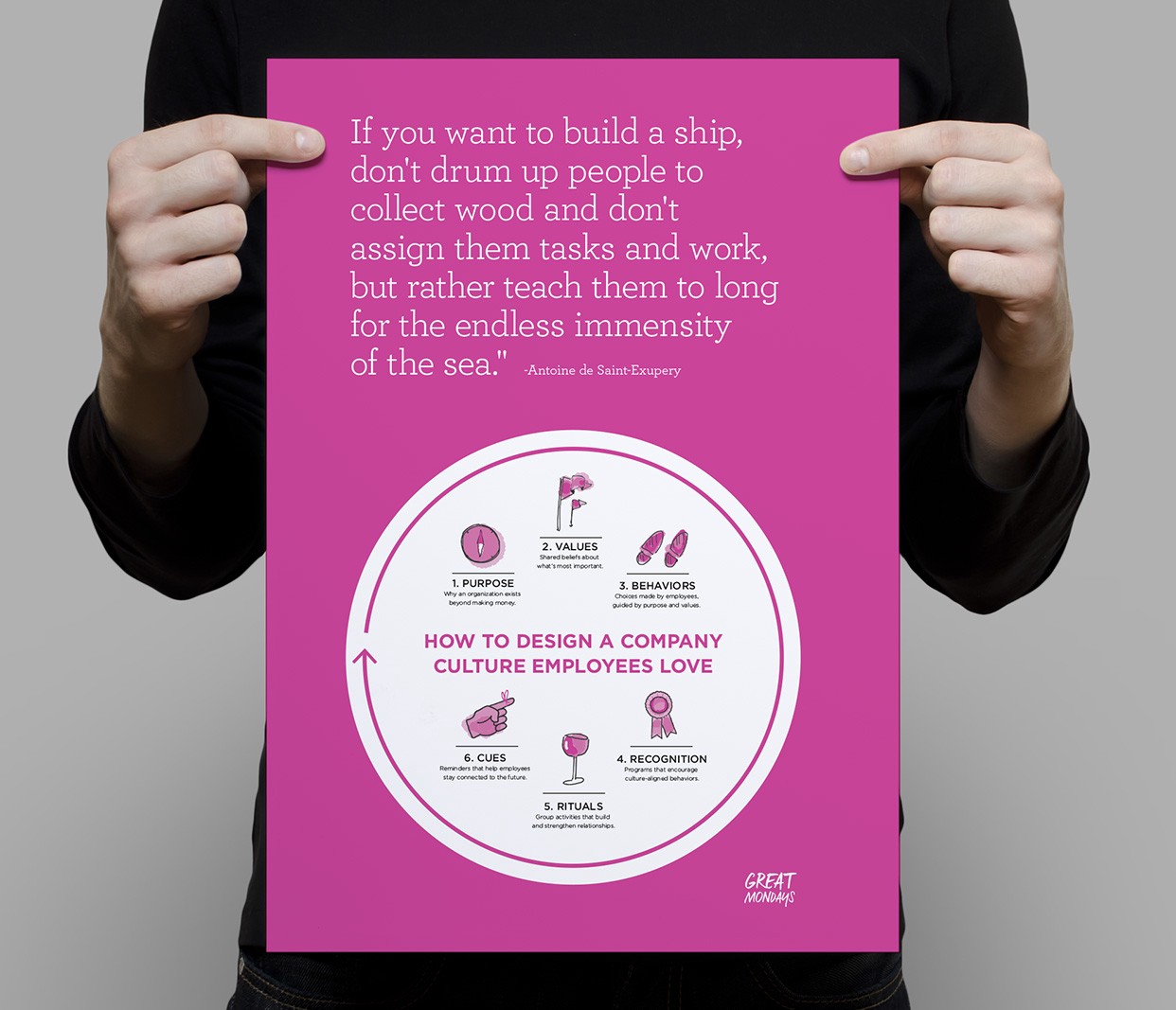
Excerpt from chapter 1 of GREAT MONDAYS: How to design a company culture employees love.

What will it take to be a place people not only want to work, but love to work? A persistent and consistent commitment to designing culture. *Persistent* because culture is a core business capability. Don’t think of it as this year’s priority; it will certainly be usurped by the next shiny business imperative that comes along. *Consistent* because the best solutions come from constraints. Design is messy. Imagining, creating, and implementing something new is hard, particularly in business. (Just ask any executive who attempted to build an innovation team.) But by having a system in which to work, the tasks become much more understandable. And do-able.

The six-part framework in this book can enable leaders at all levels in all types of organizations to imagine, create, and implement a work-life that supports employees, customers, and business. It is a process that builds on its own momentum to become a self-reinforcing system. An upward cycle that will draw in the people who want to help an organization reach its purpose.

Read more…

Equal parts visual and verbal, Shelby dances between design and strategy at Great Mondays. She’s passionate about cereal, fashion, and family.

Trust is the ultimate tool to unleash your team’s potential

Pixabay

By Sue Bingham

Trust is the keystone to managing a team. Just ask Jack who, after 17 years working job sites for a respected construction company, moved into a management role.

Once in his new position, Jack decided to replace the deadbolt on the tool room, which had been broken for years. While there were no immediate or evident concerns about the change from his team, Jack’s assistant manager asked why he felt a locked door was needed now. After all, the tool room had been consistently unlocked to no ill effect for years. The assistant manager suggested the locked door made it seem like Jack didn’t trust his team.

As Warren Buffett put it, “Trust is like the air we breathe. When it is present, nobody really notices. But when it’s absent, everybody notices.” So regardless of his team’s response, we’d be remiss in believing employees hadn’t noticed Jack’s first act as a leader involved locking all supplies away from them. This inadvertently tarnished trust — even if it was never Jack’s intention.

Distrust in the workplace isn’t always as literal as a deadbolt. Historically, training for new leaders has centered around maintaining company rules. But focusing on making a team adhere to a set of rules does anything but show trust in your employees; it shows you don’t believe their behavior will benefit the company and their colleagues.

A team led with trust performs well: Tool rooms (or their equivalent) are unlocked, and no one needs a key. Risking a small theft isn’t as dangerous as risking the alienation of an entire team by showing you don’t trust your employees.

Read the rest of the article here…

About the Author:  Sue Bingham is the founder and principal of HPWP Group. She works closely with company leaders to analyze their organizations and facilitate the implementation of commonsense systems that have a positive impact on their organizations’ bottom line. She has a passion for helping companies embrace and transition to high-performance work environments. Sue is the bestselling author of Creating the High Performance Work Place. 

The Future of Work Manifesto: Self-Management and Emotional Self-Mastery Are The Most Powerful Skills for Business Success in the Next Decade

by Milton Pedraza & Doug Kirkpatrick

As the 21st century roars on, rapidly advancing technology such as the Internet, mobile devices and artificial intelligence, have generated intense global interconnectivity that drives massive interdependence within and between organizations and individuals. Focused on implementing technology, a ubiquitous commodity that is easier to grasp, leaders are missing the big picture of self-management and emotional self-mastery, and how these two powerful new skills will make or break organizations in the next decade and beyond.

Industrial Age organizations, and their corresponding scientific management style, are being dismantled at a torrid rate. Scientific management that views organizations as machines, instead of complex adaptive systems, and human resources processes that treat people like robots, instead of human beings, are making themselves irrelevant. Millennials, who have grown up digital and collaborative, are eagerly waiting for their current leadership to step up to the challenge. Traditional organizations are learning that the essence of new leadership is not a position in a hierarchy, or a static job description. Leadership now requires the humanistic expertise to design purposeful and meaningful work for human beings that inspires them to join an organization. It requires designing and building an organizational context: the connective tissue, or scaffolding, required to create a highly adaptive, open system that enables human beings to grow, and express their creativity. This mastery of new skills will generate massive value through collaborative human relationships across internal and external networks. The future of work requires the symbiotic new skills of self-management and emotional self-mastery from every worker.

Self-Management: The Why and What of Work

Organizational self-management is the philosophy of individuals freely and autonomously performing the traditional functions of management (planning, organizing, coordinating, staffing, directing, controlling) guided by principles and without mechanistic hierarchy or arbitrary, unilateral command authority over others.

Read the rest of the article here…

Are Your Slack Chats Accidentally Destroying Your Work Culture?

https://www.rawpixel.com/image/391651/group-diverse-people-using-digital-devices

by Lydia Dishman

Most of us who use Slack (or other instant messaging platforms) to communicate with colleagues don’t spend a lot of time thinking about how we are saying what we say. It’s just quick chat, after all. But according to Anna McGrath, a partner in culture and transformation at the design firm Godfrey Dadich Partners, we should all be more conscious about this kind of seemingly casual conversation.

“Slack shows us exactly as we are,” McGrath asserts. “We are all a walking billboard for who we are and our current evolution,” she explains, for better or for worse. Taken together over time, unconscious Slack messages can serve to undermine a company culture.

McGrath noticed this several years ago when she was working with a client and talking about fear in the organization. The example this staff member gave was a Slack communication that was intended to be feedback but quickly devolved into public shaming. Although McGrath doesn’t recall the particulars of the message, she does remember that it was delivered in a public channel with 25 members, and it was the first time this person had heard this feedback.

Read the rest of the article here…


Lydia Dishman is a reporter writing about the intersection of tech, leadership, and innovation. She is a regular contributor to Fast Company and has written for CBS Moneywatch, Fortune, The Guardian, Popular Science, and the New York Times, among others.

Would you hire 10 people to have only 3 working?


by Brooke Erol

Probably you are saying “of course not”. It sounds ridiculous, right? Well, this is what we have done over the last decades. We never got rid of the industrial age mindset that told us how to hire and “manage” people. We never let go of the belief that work is only to pay the bills and if we are lucky to use some of our skills. We still assumed people need to be told what to do, not to be trusted, and to be controlled. We told them not to bring their whole selves but only the professional skills they have to work. Women were even told to act like a man since it was a man’s world. All those emotions we women have had no place at work. We were supposed to have fun after work: at night and during weekends. If we had bigger dreams that do not fit into that schedule, then we could wait until we retire. If we had to take care of someone we love, we better find some help, especially if it is going to take us away from the office for long hours. If we had to leave to look after someone, then we felt guilty like we were doing something wrong; like our priorities are out of place. Work needed to come first. We felt like if we come to the office earlier and leave late, people saw us as a hard worker: we sacrifice our beautiful personal life and prefer to work. If we complained about how much work we have, how hard our work is, we got more positive attention. If we played with the big guys at work, we knew we would promote faster.


Read the rest of the article here…

Brooke Erol is an advisor, a speaker, and an author who is interested in the future of work and how organizations can thrive in this new world. She works with executive teams to increase employee engagement, lower turnover rates, and hire the right people based on both culture and job-fit using a three-phase methodology that uses Emotional Intelligence practices.  She is the author of Create a Life You Love. Her purpose in life is to help as many individuals and organizations as possible to find their purpose and actualize it. You can connect with Brooke on her website or on Twitter (@boerol1).

It’s Time to Hire a Different Kind of HR Leader

by Sue Bingham

Last month, I spoke with a former human resources director who had recently quit her high-paying job at a large company where she felt required to treat people with suspicion, devoid of dignity. She simply couldn’t take it anymore.

Facing such a crisis of values is a common experience for many progressive HR leaders. Companies end up driving these individuals away instead of empowering them to make a significant impact, both culturally and financially.

HR’s Frankenstein

Traditional HR training has created a monster.

Because HR doesn’t typically have a seat at the executive table, its true purpose — employee support — is frequently overshadowed by other responsibilities, such as recruiting, handling compensation, and onboarding.

While many people enter the HR field wanting to become employee advocates, traditional training mostly equips them to plan appreciation picnics and control employee behavior in an effort to mitigate risk to the company, rather than a function that can reduce costs. Ochsner Health System, for example, instated a rule that forces employees smile and make eye contact if they are within 10 feet of someone.

Absurd rules like this exist because company leaders are terrified of being sued. Although actual lawsuits are rare, HR leaders are turning to lawyers, who encourage them to enforce irrational policies and procedures to avoid headline-making jury verdicts that grant costly awards. Adding to the perception that HR should be responsible for preventing employment-related charges, HR members are often given inappropriate authority to hire, fire, and deal with employee relations issues.

Too often, leaders view HR as an unavoidable overhead cost needed mainly to protect the company. However, HR done right can foster a culture where people thrive, saving companies hundreds of thousands of dollars in costs related to absenteeism, turnover, process streamlining, and employee engagement.

This can only be accomplished when an HR department models behavior that champions such a culture and equips other leaders to do the same. To thrive, employees at every level need to be treated as unique individuals and be given opportunities to contribute their wide variety of knowledge and experience.

Here are three ways to abolish outdated, traditional HR management and revolutionize your company from within.

Read the rest of the article here…

About the Author:  Sue Bingham is the founder and principal of HPWP Group. She works closely with company leaders to analyze their organizations and facilitate the implementation of commonsense systems that have a positive impact on their organizations’ bottom line. She has a passion for helping companies embrace and transition to high-performance work environments. Sue is the bestselling author of Creating the High Performance Work Place. 

Haier Elevation

by Doug Kirkpatrick

An Overview

A hungry dragon is stirring in the Far East. Its name is Haier.

In the fall of 2012, I visited Haier (pronounced “higher”) headquarters in Qingdao, China to meet its legendary Founder and CEO, Zhang Ruimin, its Cofounder Ms. Yang Mian Mian, and other key leaders to discuss and debate the theory and practice of organizational self-management.

Accompanied by Leighton Gao, senior manager of Haier’s Corporate Culture Center (and interpreter extraordinaire), my hosts arranged a tour of the Haier heritage center, where visitors are greeted by a giant sledgehammer—symbol of Haier’s birth in 1984. Walking through the center and reflecting on Haier’s journey, one feels the power of their story from humble origin to global business legend.

According to Haier’s website, in 1984 young entrepreneur Zhang Ruimin took a post as Director of Haier’s precursor, the Qingdao Refrigerator Factory. At the time, the company was drowning in debt and only produced about 10,000 refrigerators each year, with terrible quality. Workers were so unkempt and dysfunctional that Zhang had to stop them from urinating on the shop floor. In frustration, he lined up 76 refrigerators, handed out sledgehammers, and issued a command to the workers: “Destroy them!” Zhang himself smashed one of the defective refrigerators to drive home his key point: the existing culture must be demolished and replaced.[1] Out of this primal act of catharsis, the modern Haier Group was born.

Read the rest of the article here…

Doug Kirkpatrick is the author of Beyond Empowerment, The Age of the Self-Managed Organization. He is an organizational change consultant, TEDx and keynote speaker, executive coach, writer, educator, and SPHR.

He played the first season of his business career in the manufacturing sector, principally with The Morning Star Company of Sacramento, California, a world leader in the food industry, as a financial controller and administrator. He now engages with the Morning Star Self-Management Institute, Great Work Cultures, The Center for Innovative Cultures and other vibrant organizations and leaders to co-create the future of management. Contact Doug at Twitter @Redshifter3.

Digital Transformation – Part VII: The Human-Machine Symbiosis

By Rod Collins

Over three days from February 14 – 16, 2011, the American public was introduced to the amazing capabilities of artificial intelligence (AI) during the telecast of the Jeopardy! IBM Challenge, when IBM’s Watson faced off against Ken Jennings, the holder of the record for the game show’s longest winning streak, and Brad Rutter, Jeopardy!’s all-time money winner. This much-publicized human-versus-machine competition turned out to be no contest at all, as Watson easily beat its human challengers with a score of $77, 147 to Jennings’s $24,000 and Rutter’s $21,600.

With this remarkable victory, the public learned what was once considered science fiction was suddenly scientific reality: computers could interact with humans in intelligent conversation. Watson wasn’t a linear program following a series of pre-planned fixed steps, like a dishwasher. It was an intelligent machine that could absorb spontaneous human communication and could respond sensibly. And what was most impressive is that it could do so far smarter and faster than the long-running game show’s two greatest champions.

An Unsettling Concern

This new reality, while incredibly awe-inspiring, was also unsettling for many. Now that we had first-hand experience with the quality and speed of AI, we could understand why some were concerned that, sometime in the near future, superintelligent robots might develop to the point that they could overtake or even subjugate humans. However, this thinking may be shortsighted because it reflects the prevailing hierarchical mindset, which assumes power is a function of being in charge and, therefore expects humans and machines to behave as separate and competing entities embroiled in a battle to see who comes out on top. If this hierarchical mindset continues to shape how we think and act, this concern could eventually morph into what many would consider a clear and present danger.

Read the rest of the article here…

About the Author:  Rod Collins (@collinsrod) is the Innovation Sherpa at Salt Flats and the author of Wiki Management: A Revolutionary New Model for a Rapidly Changing and Collaborative World (AMACOM Books).

Scaling Culture — part two

by Josh Levine

This article is second in a series exploring the why, when, and how of managing company culture in growth organizations by Josh Levine.

The Moment It All Goes Wrong

If you’ve ever had to work with another human, you know good relationships make for good work. These bonds are the conduits of culture, and while they don’t guarantee success, you can be sure it ain’t happening without them. Think of relationships as connective tissue: take this essential layer away and business would just be a pile of old laptops and financial documents.

No blue chip CEO will argue the point: the human side of business is critical to success. But how does this system of relationships change as startups emerge from their proverbial garages with dreams of long-term success? In post one, I proposed an answer: relationship decay. As co-workers increase in number our brains have to work harder to remember all the names, faces, and details. We are forced to choose who we know and how well.

Why should anyone care about relationship decay? It is the reason startup cultures fail.

Without foresight and guidance, startup cultures weaken with growth. It’s hardly noticeable at first, but when it gains momentum employees will look up and no longer know all of the who’s and what’s that make the organization work. This is it: the moment culture is at greatest risk of unraveling. If we can see it coming maybe we can prepare for it.

Read more…

Josh Levine is an educator, designer, and author, but above all, he is on a mission to help organizations design a culture advantage.

2